
Knee pain and the meniscus: what's really going on inside your knee, and what you can do about it at home
Stiff first steps in the morning, a knee that "catches" on the stairs, an ache after a long day on your feet. For many Australians, the story starts with a small piece of cartilage most of us have never heard of.
Editorial team · 7 minute read

You sit on the edge of the bed and, before you've even stood up, you're already thinking about your knees. The first few steps feel stiff, you reach for the handrail on the stairs, and that long walk on the weekend suddenly needs a second thought.
Knee pain is one of the most common reasons people see a GP or physio. Yet many of us put up with it for years, telling ourselves it's just part of getting older. Health professionals say that this is often where the trouble starts.
How people are caring for their knees at home →Meet your meniscus
Inside each knee sit two rubbery, C-shaped pads of cartilage called the menisci, one on the inner side of the knee and one on the outer side. They act like shock absorbers between your thigh bone and shin bone, spread your body weight across the joint and help keep the knee stable every time you walk, squat or take the stairs.
Because they work so hard, they're also one of the most commonly injured parts of the knee. A meniscus can tear in two quite different ways:
A sudden twist
Turning quickly while your foot is planted and your knee is bent. Think netball, footy, tennis, or simply slipping on a wet step. This is the classic sports injury.Gradual wear over the years
From around middle age the meniscus becomes less elastic, so it can tear with an everyday movement, like getting up from a squat, or with no single injury at all. Many people never notice the moment it happens and only feel symptoms later.
Signs your meniscus may be involved
Not every sore knee is a meniscus problem, but these are the symptoms people describe most often:
- Pain along the inside or outside of the knee, often worse when twisting or squatting.
- Swelling and stiffness, sometimes building up over a day or two after an awkward movement.
- Catching, clicking or locking, as if something is getting in the way inside the joint.
- A feeling that the knee might give way, especially on stairs or uneven ground.
- Trouble fully straightening the leg.
Knee pain can also come from other causes: worn cartilage (osteoarthritis), weak thigh and hip muscles, old ligament injuries, extra body weight, long hours of sitting, or even problems in the hip or back. Often several of these add up together.
How people are caring for their knees at home →
- your knee locks and you can't straighten it,
- you can't put weight on your leg,
- the knee swells up quickly after an injury,
- it's red, hot to the touch or you feel unwell or feverish,
- the pain lasts longer than two weeks or keeps getting worse.
What the research says actually helps
For years, keyhole surgery was a common answer to a torn meniscus. More recent research has changed that thinking for the wear-related tears that are typical from middle age onwards.
In a trial published in The BMJ, 140 adults with an average age of about 50 and a degenerative meniscus tear were given either keyhole surgery or 12 weeks of supervised exercise therapy. After two years, the exercise group did just as well as the surgery group. Only about one in five people in the exercise group went on to have surgery later.
Health professionals generally agree on a few things that make sense for most sore knees:
- Keep moving. Walking, cycling, swimming or aqua aerobics keep the knee in shape without hard impact.
- Strengthen the muscles around the knee. Strong thighs, hips and core take load off the joint. A physio can tailor exercises to you.
- Take some weight off. Every extra kilo is carried with every single step.
- Wear supportive shoes. Cushioned soles reduce the jolt each time your foot hits the ground.
- Pace yourself. Build up activity gradually rather than doing a lot all at once on the weekend.
Physios often use a simple rule of thumb, a pain traffic light. On a scale from 0 to 10 during or after exercise:
If your knee feels worse the next day, the load was too much, so dial it back next time.

Ice or heat?
It's the question people ask most. The general rule is simple:
- Ice is for the first few days after a fresh injury or whenever the knee is swollen. Wrap it in a cloth and use it for 10 to 20 minutes at a time.
- Heat suits longer-term stiffness and tight muscles, for example first thing in the morning or at the end of a long day. Around 10 to 15 minutes is plenty, never directly on bare skin, and not on a knee that's swollen.
That's why for everyday stiffness, many people like the combination of gentle warmth and a light vibration massage. The warmth feels soothing, the vibration helps the muscles around the knee relax, and getting moving afterwards feels easier.
Knee care that fits into your day
Hot packs go cold, creams get messy and a massage appointment isn't always an option. That's why heated knee massagers have become popular: you sit down, switch it on and let your knees unwind for a few minutes. At home, in front of the TV or with a book.
Introducing Reliva
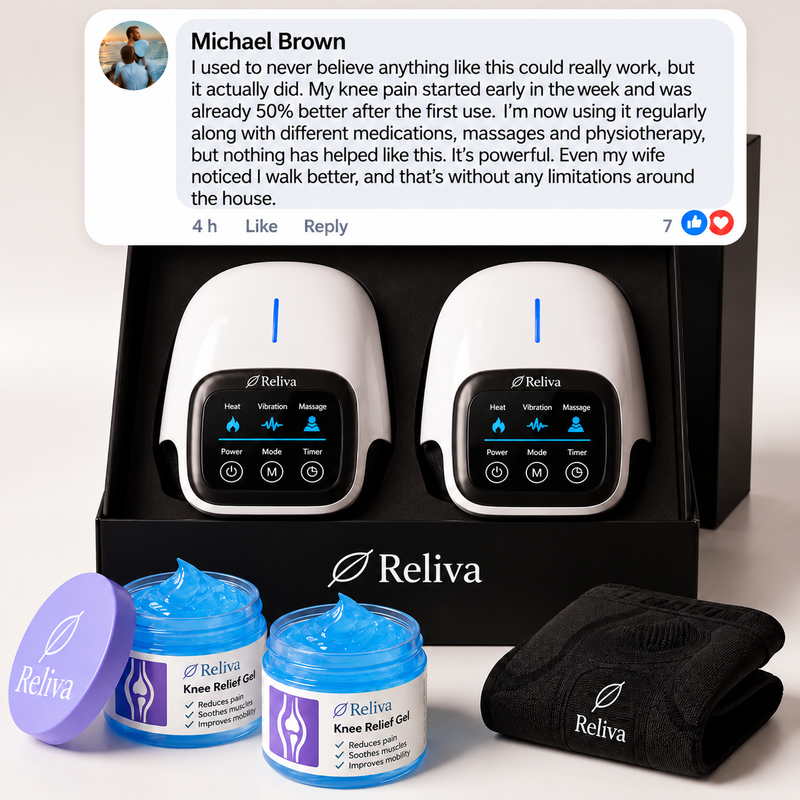
Reliva is a heated, vibrating knee massager designed for comfortable relaxation at home. It wraps around the knee, warms it gently and adds a soft vibration massage.
- Soothing warmth: gentle heat up to 36 °C.
- Relaxing vibration: a light massage around the knee.
- 3 intensity levels: choose what feels right for you.
- Comfort at home: no appointments, no travel, and it works on the shoulder too.
How to fit Reliva into your day
Reliva is designed for comfort and relaxation. It is not a medical device and does not diagnose, treat or replace care from your GP or physiotherapist. If your knee has just been injured or is swollen, use ice and get it checked first.
 See Reliva →30-day money-back guarantee
What customers say
It's lovely especially after a long walk. I like that I don't have to hold anything and can just sit normally.
I mostly use it in the evening in front of the TV. The heating is really pleasant and the controls are simple.
A good buy for me. I use it after work when my legs are tired, and those 15 minutes are a nice break.
Frequently asked questions
Is Reliva right for me?
Reliva is designed for relaxing and warming the knees at home. If you have a medical condition, a pacemaker or an implant, are pregnant, or aren't sure, check with your doctor first.
Can I use it on a fresh knee injury?
No. For the first few days after an injury, or whenever the knee is swollen, ice is the better choice. See your GP if the knee locks, gives way or you can't put weight on it.
Can I use it anywhere else?
Yes, it also works on the shoulder.
Does it replace my GP or physio?
No. Reliva is for comfort at home. If pain lasts or gets worse, see a health professional.
What if it's not right for me?
You have 30 days to get your money back.

Give your knees a few minutes
Warmth and vibration massage in one device, anytime at home.
30-day money-back guarantee
This article is based on publicly available health information, including research on degenerative meniscus tears published in The BMJ (Kise et al., 2016). It is general information only and does not replace an examination or advice from your doctor.